Only between 1% and 3% of B2B website visitors ever identify themselves, with a median of 1.9% across 24 tracked industries [source: FirstPageSage] . The other 98% divide four ways: they found what they needed and left, they didn't find it and went to a competitor, they abandoned a form partway through, or they had a question but weren't willing to become a sales lead in order to ask it. Half of those groups leave with an unanswered question, and most companies have no record of what it was.
What is a normal B2B website conversion rate?
The number swings widely by industry, and the definition matters as much as the figure. Everything below counts any conversion action divided by total unique visitors, measured across 24 B2B industries.
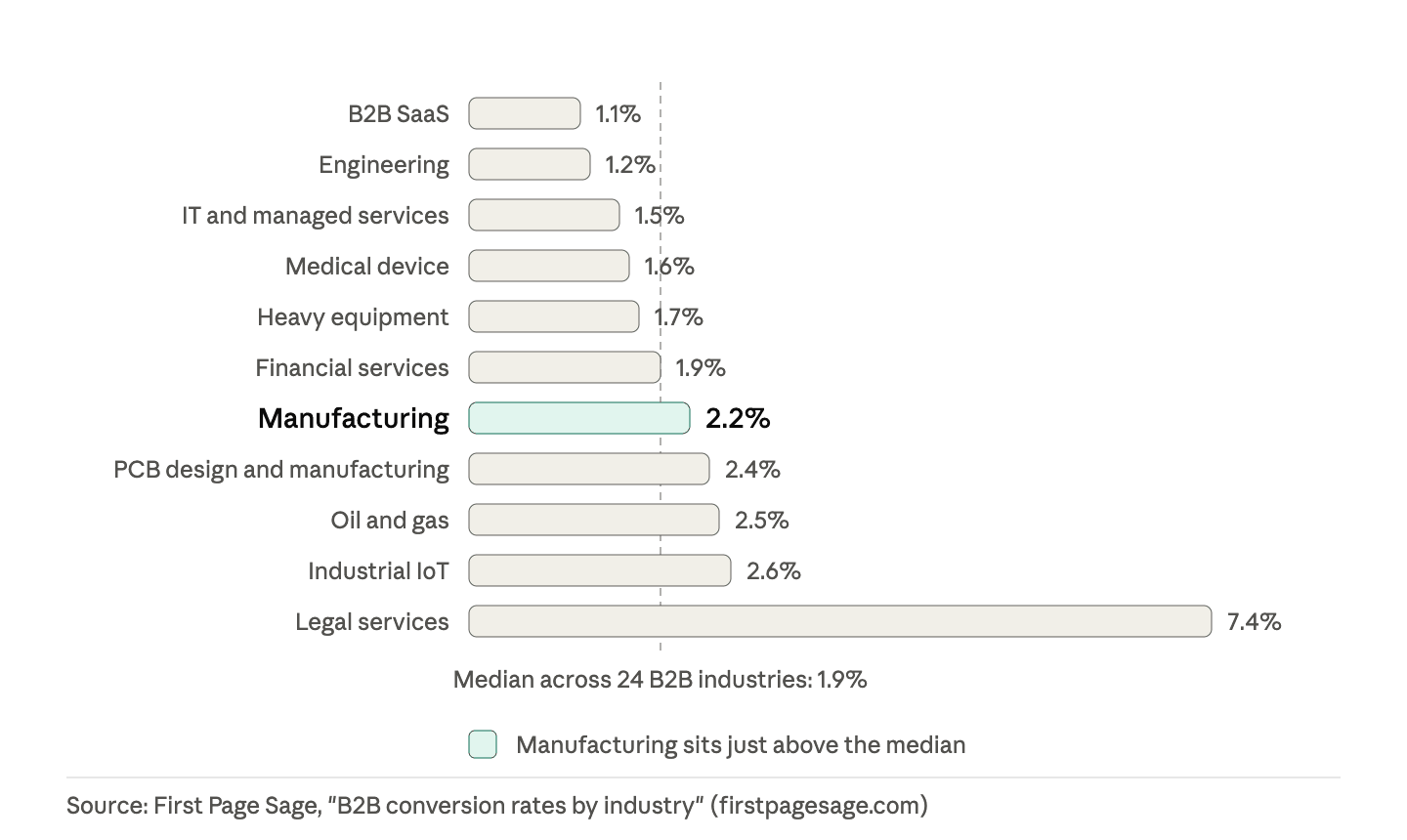
Legal services is the outlier, at nearly seven times the B2B SaaS rate, because legal search traffic arrives with unusually high intent. Everything an industrial or technical company should compare itself against sits between 1.1% and 2.6%.
A separate dataset covering more than 100 million tracked conversions puts the cross-industry average higher, at 2.9% visitor-to-qualified-lead, rising to 5.13% once phone calls and live chat count alongside form fills. The gap between the two is a definition problem rather than a disagreement. Before comparing yourself to either, work out which one your analytics is actually measuring. For perspective on how normal these numbers are: even Salesforce converts under 5% of its traffic into qualified leads.
Why a 2% conversion rate is not a website problem
A 2% conversion rate sounds like something is broken. It usually isn't, at least not in the way people assume.
Gartner's research on B2B buying found that the average business purchase involves 6 to 10 people and takes between 3 and 18 months. A conversion in that world is rarely a single moment. Someone from engineering reads your spec page in March. Procurement pulls up your pricing in June. The person who eventually signs may never visit your site until the contract stage. So the 98% is not a pile of failures. Some of it is early-stage research by people who will buy from you next year. Some of it is competitors. Some of it is a buying committee member gathering evidence for an internal argument you will never see.
The problem is that you learned nothing from any of them.
What actually happens to visitors who don't convert
They fall into four groups, and the difference between the groups is the whole story.
- They found what they needed and left. A distributor checking whether your fitting comes in 316 stainless. They got the answer from your spec sheet, wrote it down, and closed the tab. This is a success you never recorded, and it will show up in your analytics as a bounce.
- They didn't find what they needed and left. The spec sheet covers 316 but says nothing about temperature rating, and the person needed to know whether it holds at 180C. They went to a competitor's site to check. This is a lost deal that looks identical to the first group in every report you have.
- They started a form and abandoned it. Form abandonment in the 25% to 40% range is normal in B2B. HubSpot's analysis of more than 40,000 landing pages found conversion rates dropped consistently as forms grew from 3 fields to 7 or more. Asking for company size and job title before answering a technical question is a reliable way to lose a technical buyer.
- **They wanted to ask a question but weren't ready to identify themselves. **This is the largest group and the least visible. Filling out a contact form in B2B means committing to a sales conversation. Plenty of people at the research stage will not do that for a single question, particularly if that question is small and specific.
The second and fourth groups are you need to focusing for conversion. Both left with an unanswered question. Neither left a trace of what it was.
Why your existing tools can't tell you which group someone was in.
This is the part that surprises marketing teams, because if you spend your week inside GA4 and a heatmap tool, it feels like the data must already be in there somewhere.
Analytics shows behaviour, not intent. GA4 will tell you that a product page has a 74% exit rate. It cannot tell you whether people exited because they got their answer or because they gave up. Those two outcomes need opposite responses, and your dashboard treats them identically.
Session recordings show movement, not thought. Watching a cursor hover over a spec table for eleven seconds tells you that something on that table mattered. It doesn't tell you what the person was hoping to find there and didn't.
Visitor identification tools give you a company, not a question. Knowing that someone from a mid-size pump manufacturer visited your bearings page three times is useful for sales outreach. It still doesn't tell your marketing team which specification was missing. Heatmaps aggregate away the specific. A heatmap shows you where attention pooled across hundreds of sessions. The individual question that forty people had and nobody could answer disappears into the average.
Every one of these tools measures the visitor. None of them capture what the visitor wanted to say. That gap is structural rather than a matter of buying a better dashboard, because none of these tools give the visitor anywhere to speak.
What it would actually take to close the gap
Working backwards from the problem, four things have to be true.
The visitor needs somewhere to ask a question on the page, at the moment the question occurs to them, while they are still looking at the thing that prompted it.
They need to be able to ask without giving up an email address first, because the whole point is reaching people who aren't ready to be a lead.
The question has to get answered accurately from your real documentation, since a wrong answer about a temperature rating is worse than no answer.
And every question has to be recorded, classified, and read by someone, because a log nobody looks at is not a feedback loop. This last requirement is the one most companies skip, and it's the one that turns the exercise from a support feature into marketing intelligence.
Meet the first three and you have a helpful website. Meet all four and your website starts telling you what your buyers actually want to know.
How Illumea approaches this
Illumea is built around the fourth requirement rather than the first.
The chat interface on the page is the part visitors see: they ask a question, and it answers from your product documentation, spec sheets, and catalogue rather than from a general model that might invent a number. That much is table stakes now, and several tools do it.
The part we treat as the differentiator is what happens to the questions afterwards. Every conversation is logged and sorted into categories that a marketing team can act on. Questions your documentation answered well. Questions it answered badly. Questions it couldn't answer at all, which are your content gaps, stated in your buyers' own words. Questions that carry a buying signal, like someone asking about lead times, minimum order quantities, or compatibility with a named competitor's part. And off-topic questions, kept separate, so a genuine gap isn't buried under people asking about job openings.
Once a month, that becomes a report: what your visitors asked, what you couldn't answer, and which pages to write next. We run it as a managed service rather than a self-serve signup, which means we handle the knowledge base setup and the classification rather than handing you a dashboard and wishing you luck. That suits companies with a deep technical catalogue and no in-house AI resource, and it suits companies with a compliance requirement about what a chatbot is allowed to claim.
If you want to see what your own visitors have been trying to ask, get in touch and we'll set up a pilot on a single product section.
FAQ
What is a good B2B website conversion rate? Between 1% and 3% is normal, with a median of 1.9% across 24 B2B industries. Manufacturing sits at 2.2% and B2B SaaS at 1.1%. Landing pages built specifically for capture convert higher, at 5% to 15%, but those figures are not comparable to whole-site rates.
Why is my B2B conversion rate lower than B2C benchmarks? B2B purchases involve more people and longer timelines. Gartner found the average business purchase involves 6 to 10 stakeholders over 3 to 18 months. A 2% rate on a $50,000 deal is a healthier business than an 8% rate on a $50 order.
Does the 98% who leave include bots? Some of it, yes. Before drawing conclusions about your conversion rate, check bounce rate and conversion by traffic source. Paid traffic and organic traffic behave differently enough that a blended number can hide the real picture.
How do I find out what anonymous visitors wanted? Analytics show behaviour, not intent. To learn what someone wanted to know, you need a channel where they can ask without identifying themselves, and a process that reads and classifies what they asked. Session recordings, heatmaps, and visitor identification tools all measure the visitor rather than capturing the question.
Is a higher conversion rate always better? Not necessarily. Aggressive gating can raise the recorded rate while lowering pipeline quality, because you capture people who wanted a whitepaper rather than people who wanted a supplier.
Won't adding a chatbot just annoy visitors? It will if it interrupts them with a scripted greeting or can't answer a technical question. The failure mode people remember is a bot that loops. A chat layer grounded in your real documentation, which says it doesn't know rather than guessing, behaves differently.
Sources: First Page Sage, "B2B Conversion Rates By Industry" (2026 edition, client data January 2022 to August 2025, 24 industries); Ruler Analytics 2026 conversion benchmark report (100M+ tracked data points); Gartner B2B Buyer research; HubSpot analysis of 40,000+ landing pages.